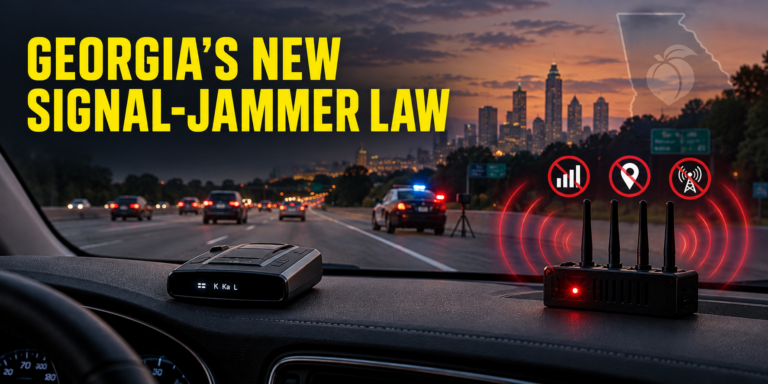
Georgia has enacted a sweeping new law targeting devices that interfere with wireless communications. The Emergency & Public Safety Signal Protection Act, also known as Senate Bill 470, took effect on July 1, 2026.
The law is broader—and the consequences are more serious—than many drivers may expect. It does not apply only to someone attempting to interfere with police speed-enforcement radar. It covers devices capable of disrupting cellular communications, GPS, radar systems, wireless networks and other communication systems.
For drivers, however, the new law raises an important question: Does Georgia’s signal-jammer ban also make radar detectors illegal?
The short answer is no. A conventional radar detector and a signal jammer work differently, and Georgia’s new law is written around devices that emit a signal to interfere with another system. Here is what Georgia drivers should understand.
What Does Georgia’s New Signal-Jammer Law Prohibit?
Georgia Senate Bill 470 created O.C.G.A. § 16-11-46. It defines a “signal jammer” as a device that emits a signal capable of preventing, disrupting, delaying, degrading or otherwise interfering with a communication signal transmitted over:
- A wireless communications system;
- A cellular communications system;
- A radar system;
- A global positioning system;
- A radio, telephone or cable line, station or system.
The law generally makes it illegal to possess, use or operate one of these devices with the intent to interfere with a communication signal. It also prohibits possessing, manufacturing, selling, offering for sale, distributing or importing a signal jammer in Georgia, subject to limited exemptions for federally authorized activities and certain public-safety or law-enforcement uses.
That means a device does not need to be actively operating for someone to face potential exposure under the portion of the law governing possession, manufacturing or sale.
Georgia’s Signal-Jammer Penalties Are Felonies
This is not treated as a minor equipment violation or an ordinary traffic ticket.
Under the new law, possessing, using or operating a jammer with the required intent is generally punishable as a felony by:
- One to seven years in prison;
- A fine of up to $10,000; or
- Both imprisonment and a fine.
The potential punishment increases when the conduct is intended to interfere with a public-safety agency, a 911 center or critical infrastructure. That offense can carry:
- One to ten years in prison;
- A fine of up to $25,000; or
- Both.
Possessing, manufacturing, selling, distributing or importing a prohibited signal jammer can carry one to five years in prison, a fine of up to $10,000, or both. The law also allows devices and other property used to facilitate a violation to be treated as contraband and subjected to forfeiture.
The exact charge will depend on the device, what it was designed to do, how it was possessed or used and the evidence of intent.
Radar Detectors and Signal Jammers Are Not the Same Thing
The terms are sometimes used interchangeably online, but the technology and legal treatment are different.
What a radar detector does
A traditional radar detector is a passive receiver. It listens for radio frequencies commonly used by police radar equipment and warns the driver when it detects them.
The key point is that a conventional detector receives a signal. It does not ordinarily transmit interference back toward the radar gun.
Georgia’s new law defines a signal jammer as a device that interferes “through emitting a signal.” Based on that language, an ordinary passive radar detector does not fit the new definition merely because it alerts a driver to radar activity.
Radar detectors are generally legal in private passenger vehicles in Georgia. That does not make them legal everywhere or for every vehicle. Federal regulations prohibit radar detectors in commercial motor vehicles weighing more than 10,000 pounds, and detectors are prohibited on military installations. Virginia and Washington, D.C., also prohibit their use in vehicles.
What a radar jammer does
A radar jammer is active rather than passive. It transmits radio-frequency energy intended to confuse, overpower or interfere with a radar device.
That distinction puts a radar jammer directly within the conduct targeted by Georgia’s new law. Radar jammers are also illegal under federal law. The Federal Communications Commission has long prohibited consumers from operating, marketing or selling devices designed to jam authorized radio communications.
Calling a product a “scrambler,” “privacy device” or “radar blocker” does not necessarily change how it will be treated. Authorities can examine what the device actually does rather than relying on its marketing label.
What About Laser Jammers?
Police may measure vehicle speed using radar or lidar. Radar uses radio waves. Lidar—often called police laser—uses pulses of light.
A laser jammer attempts to interfere with a lidar gun by transmitting light back toward it. Because the FCC regulates radio-frequency interference, the federal radio-jamming prohibition does not operate in exactly the same way for laser-based devices. Several states have therefore enacted statutes specifically prohibiting laser jammers.
Georgia’s new statute expressly refers to devices that interfere with wireless, cellular, radar and GPS systems, but it does not expressly use the terms “lidar” or “laser jammer.” Drivers should not interpret that omission as approval to use one. A device’s legality can depend on its design, the signals it emits, how it is marketed and the circumstances in which it is used. Other obstruction, equipment or criminal laws could also become relevant.
Other States Also Restrict Jammers and Detectors
Georgia is not acting in isolation. Federal law already makes radio-frequency jammers illegal throughout the United States, but states have adopted additional laws addressing particular devices or conduct.
Examples include:
- California: California Vehicle Code § 28150 prohibits possessing or using a device designed to jam, scramble, neutralize, disable or otherwise interfere with police radar or laser equipment.
- Texas: Texas Transportation Code § 547.616 prohibits purchasing, selling or using a radar-interference device in a motor vehicle, subject to limited exceptions.
- Virginia: Virginia Code § 46.2-1079 generally prohibits radar detectors as well as devices or mechanisms intended to interfere with radar or other speed-measurement equipment.
- Minnesota: Minnesota law prohibits devices used to interfere with or neutralize speed-measuring equipment.
States commonly identified as having specific restrictions on laser-jamming devices include California, Colorado, Illinois, Iowa, Minnesota, Oklahoma, South Carolina, Tennessee, Texas, Utah and Virginia. The wording and penalties vary significantly, so drivers crossing state lines should not assume that a device legal in one jurisdiction is legal in another.
Virginia and Washington, D.C., are also notable because they restrict passive radar detectors, not only active jammers. Federal rules separately restrict radar detectors in many commercial vehicles.
Why Georgia Passed the New Law
The legislation focuses heavily on emergency communications and critical infrastructure. A jammer can interfere with much more than speed-enforcement equipment. Depending on its capabilities, it could prevent a person from completing a 911 call, disrupt GPS navigation, interfere with emergency dispatch or disable wireless alarm and tracking systems.
Georgia lawmakers characterized the measure as a public-safety protection. The enhanced penalty for interference with 911 centers, public-safety agencies and critical infrastructure reflects that focus.
For motorists, the law is a reminder that a small electronic device carried in a vehicle could create consequences far beyond a speeding citation—particularly if it actively transmits interference.
What Georgia Drivers Should Do
Drivers should check exactly what a device is designed to do before buying, installing or carrying it. Product listings can be misleading, and some online sellers may market equipment that cannot legally be sold or operated in the United States.
Keep these distinctions in mind:
- A passive radar detector listens for radar signals.
- A radar jammer emits radio-frequency interference and is illegal under federal law as well as Georgia’s new statute.
- A laser jammer targets lidar equipment and is specifically prohibited in a number of states.
- A cellular or GPS jammer can interfere with emergency and public-safety systems and falls squarely within Georgia’s new law.
If law enforcement finds a suspected jammer during a traffic stop, the situation may extend well beyond the original reason for the stop. Do not assume the matter is merely a traffic citation, and do not make statements about the device’s intended purpose without first understanding the potential consequences.
Charged With a Traffic Offense in Georgia?
The Ticket Clinic helps drivers understand their options after receiving a traffic citation in Georgia. Every case is different, and the available defenses and consequences depend on the charge, the court and the driver’s record.
Text a picture of your ticket to 305305 for a fast and free quote.
This article is for general informational purposes only and does not constitute legal advice. Laws and interpretations can change. Consult an attorney about your specific situation.